


BEFORE YOU PRESS RECORD
You filmed
their worst dayWhy?
When someone else’s pain becomes content, what happens to the person inside the frame?
LET’S LOOK CLOSER ↓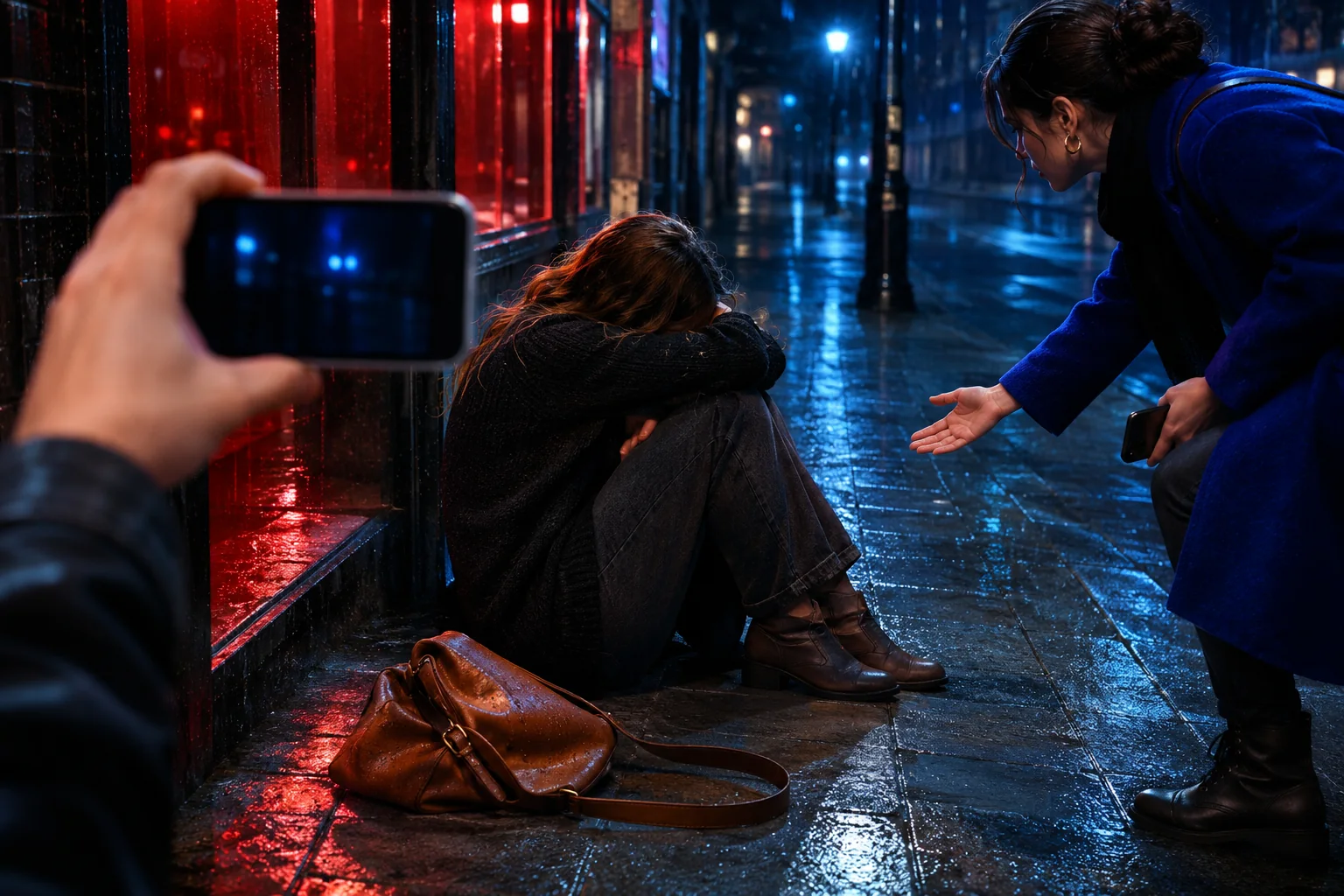
Did they get an audience?
NOT A POST
Your next post.
Their life after it.
Filming. Helping. Sharing.
And the space between them.
Inside this story 08 CHAPTERS +
01 / BEFORE YOU PRESS RECORD
A person, before a post
Imagine a woman crying outside a restaurant. You do not know whether she has just received terrible news, been humiliated by someone she trusted, or reached the end of a day she could no longer hold together. You know she is crying. That is the whole of your knowledge. Somehow, it can feel like enough to begin filming.
The camera gives the moment a frame. A caption supplies a motive. A stranger supplies a verdict. Within minutes, someone’s confusion can become a public character assessment: dramatic, drunk, unstable, attention-seeking. The certainty arrives much faster than the facts.
This is an imagined scene, not an account of a particular incident. It matters because the choice is so recognisable. A public place does not remove a person’s private history. Being visible does not mean they have agreed to become your material.
And before we congratulate ourselves for never uploading something like that, there is another question. Have we watched it twice? Sent it to a friend? Added a laughing reaction? The person with the camera is not the only person in the room.
02 / THE MISSING FOOTAGE
The clip starts where your knowledge ends
A short recording can show what someone did. It rarely contains everything that led to it. There may be a genuine act of aggression on screen. There may also be missing information: what happened earlier, who is being threatened, whether someone is unwell, whether the recording itself has become part of the confrontation.
Context is not a magic eraser for harmful behaviour. An explanation does not automatically excuse an action. But those distinctions require attention, and attention is different from the pleasure of delivering a quick sentence on somebody else’s life.
A cropped video can leave us with the loudest person and remove the provocation. A caption can tell us whose embarrassment to enjoy before we have heard a word. Even unedited footage has a beginning chosen by the person who started recording and an ending chosen by the person who stopped.
Ask what the image establishes, what you are inferring, and what you simply do not know. You can condemn a visible action without pretending a few seconds have given you a complete biography.
03 / THE CAMERA CAN MATTER
Yes, sometimes you should document
A blanket demand to put every phone away would miss something important. Recordings can preserve evidence of harassment, violence, discrimination and abuses of power. People who are disbelieved may need a witness. An account that would otherwise disappear may survive because someone kept a camera steady.
The ethical question is what the recording is for, whose needs it serves, and what happens next. The American Psychological Association’s bystander guidance includes documentation when it is safe and someone else is already helping. Its advice puts the targeted person’s permission at the centre of sharing the material. Source ↗
That guidance concerns discriminatory incidents; it is not a universal legal rule for every camera in every country. It does, however, offer a useful order of priorities: attend to the person, consider safety, and distinguish keeping evidence from broadcasting it. Publishing to your followers is a separate decision from making a record.
If documentation is genuinely needed, avoid adding commentary that turns uncertainty into accusation. Do not obstruct assistance for a better angle. Consider a responsible route for providing relevant evidence, rather than assuming the widest possible audience is the most helpful one.
04 / THE MOMENT OF HESITATION
Why does everyone look at everyone else?
It is comforting to imagine that the only people who fail to help are cruel. Real situations can be more uncomfortable. We hesitate because we do not understand what is happening, fear making things worse, or assume someone closer has already taken responsibility.
The APA describes how uncertainty, other people’s inaction and responsibility spread across a group can inhibit intervention. These are possible influences on behaviour, not proof that any particular person holding a phone is indifferent. Nor do they mean nobody ever helps in a crowd. Source ↗
The practical response need not be heroic. From a safe position, establish whether help is already coming. Ask a staff member to assist. Give one person a specific request instead of announcing a vague plea to everyone. If there is immediate danger, contact the appropriate local emergency service and follow its instructions.
You do not owe the scene a dramatic rescue, and you should not place yourself in danger. But a useful phone call and a public upload are very different uses of the same device. The question is whether your next action changes anything for the person in front of you.
05 / OFF CAMERA
Their story does not become yours because you found it
Someone may want to tell their story. They may want a public record, recognition, accountability, or solidarity. Taking their agency seriously includes listening when they want to speak. It also includes accepting that they may not want to speak to you, now or ever.
Our Watch’s guidance for reporting on survivors warns that immediate shock can make it difficult to understand what public exposure means. It asks journalists to explain risks such as identification and online abuse, and to give survivors meaningful choices about how they are represented. Source ↗
That is guidance written for a specific reporting context. The wider ethical lesson is worth considering before an ordinary social post: the fact that somebody answered you, smiled nervously, or did not protest is not a reliable substitute for an informed conversation about publication.
Removing a face may reduce exposure, but a voice, workplace uniform, location or distinctive detail can still identify someone. Ask who might recognise them and what that recognition could cost. Your intention to raise awareness does not automatically settle those questions.
06 / NOW TURN THE CAMERA
We are the audience this depends on
A humiliating clip does not need us to approve of it. It only needs us to keep circulating it. Even a message that says ‘this is disgusting’ can carry the original humiliation into another group, another workplace, another day in somebody’s life.
Before sharing, ask what your recipient will actually learn. Is there verified information they need? A genuine safety concern? A clear public-interest purpose? Or are we offering another person’s breakdown as the afternoon’s conversation? Curiosity is real. It does not automatically create an entitlement.
There is a difference between examining a pattern and providing a searchable stranger for everyone to punish. We can discuss bullying, cruelty and irresponsible filming without repeatedly reproducing the most exposing frame. Sometimes a description gives the reader everything they need without making the person pay again.
And if you have already shared it, you can stop. Remove your own post. Ask people you sent it to not to recirculate it. You cannot promise to erase every copy. You can decide that your contribution to the problem ends here.
Three questions
worth the pause
01 What do I
actually know?
02 Who does
sharing help?
03 Could I make the point
without exposing them?
07 / WHEN THE SCREEN TURNS BACK
What if you are the person in the video?
You do not have to present a perfect public response while you are upset. If you want to challenge an upload, consider saving its link and the account details privately before reporting it. Use the platform’s reporting tools and describe the relevant concern accurately, whether that is harassment, privacy, threats or another category that applies.
A trusted person can help you review messages, document what is happening and make requests on your behalf. You do not have to watch every reaction or answer every stranger. If contacting the uploader feels unsafe, you can avoid direct contact and seek appropriate support instead.
Outcomes differ between platforms and circumstances. A takedown is not guaranteed, and a removal from one account does not remove every repost. Where threats, intimate material or serious consequences are involved, seek qualified local advice rather than relying on a comment section to tell you your options.
Most of all, the existence of the clip does not make its caption true. Your worst ten seconds are not the final, authoritative description of who you are.
08 / THE LAST FRAME
What did you do after you saw them?
There are moments worth recording because forgetting them would protect the wrong people. There are also moments whose only audience should be the people needed to help. Telling them apart takes judgement, humility and the willingness to leave with no content at all.
Before pressing record, ask whether someone needs assistance. Before pressing upload, ask whether publication serves a purpose you can defend without mentioning views. Before pressing share, ask whether you would make the same choice if the person on screen were someone you loved.
That last question is not a perfect ethical test. Strangers deserve dignity even when we cannot picture them as family. But it can interrupt the distance that makes another person’s pain feel like a harmless thing to pass around.
You saw someone having a terrible day. Perhaps you could help. Perhaps you could safely document something that needed a witness. Perhaps the most decent thing you could offer was space. Whatever the circumstances, their worst moment did not arrive in the world to provide you with something to post.
The sources.
The responsibility.
This is an opinion essay. The scenes are fictional; the photographs and decorative objects are AI-generated editorial illustrations. No real victim or incident is depicted. The linked sources inform the relevant passages; the wider argument is AJVAR LADY’s editorial view.