


Money / expectations
You can
afford it
My generosity is a choice. It is not your budget.
READ THE STORY

The bill arrives.
For a moment, nobody moves.
Then somebody looks at you.
Perhaps there is a joke about your salary. A reference to the promotion. A cheerful little reminder that this particular dinner will hardly make a difference to someone doing as well as you are.
“You can afford it.”
Maybe you can.
That still leaves a question nobody at the table seems especially interested in asking.
Did you offer?

When a gift becomes the arrangement
You paid last time because you wanted to.
Someone was celebrating. A friend was having a difficult month. You were pleased to see everyone and enjoyed being able to say, “I’ve got this.”
There can be real pleasure in that moment. In making something easier for people you love. In sharing good fortune without keeping a record of every coffee.
Then the next bill arrives.
And the next.
Your offer slowly disappears from the arrangement. Everyone remembers the part where you paid.
Nobody checks whether you would like to do it again.
A generous evening becomes a precedent. Eventually, your turn seems to come around considerably more often than anyone else’s.
You notice. You hesitate to mention it because discussing money can make an otherwise pleasant table feel very exposed.
So you pay again.
The problem begins when your offer expires but everyone keeps spending it.
Your salary has acquired an audience
Once people believe you earn well, they may begin making decisions about what your money means.
You can manage the more expensive hotel.
You can cover the difference.
You can lend the money until next month.
You can spend more on the present because, really, it would be a smaller sacrifice for you.
Sometimes these are requests made with care. Sometimes they arrive as conclusions.
You earn well, so they assume you have money to spare. Suddenly, saying no requires an explanation.
Your obligations remain largely invisible.
The savings you are trying to build. The people you already help. The uncertainty of an income that looks more secure from the outside. The plans you have not discussed because they are yours.
And perhaps there is no hidden difficulty.
Perhaps your finances are comfortable and you simply do not want to pay for this particular thing.
That possibility deserves a place in the conversation, too.
You should not have to reveal a private hardship to make your refusal acceptable.
A larger income does not make someone a better person
People arrive at different incomes through different combinations of work, knowledge, opportunity, support, circumstances and luck.
Someone may have studied for years, taken risks, built a business or worked relentlessly to reach their position.
Someone else may be working just as hard for much less.
A salary cannot tell us everything about a person’s effort. It certainly cannot measure their worth.
But recognising that does not turn the better-paid person’s income into money the group can allocate.
You can acknowledge unequal circumstances and still respect individual choice.
A friend with less money deserves dignity, inclusion and the freedom to name a budget. A friend with more money deserves the freedom to decide what they give.
Both should be able to participate without being reduced to their finances.
Friendship should have room for different incomes without assigning one person the role of sponsor.

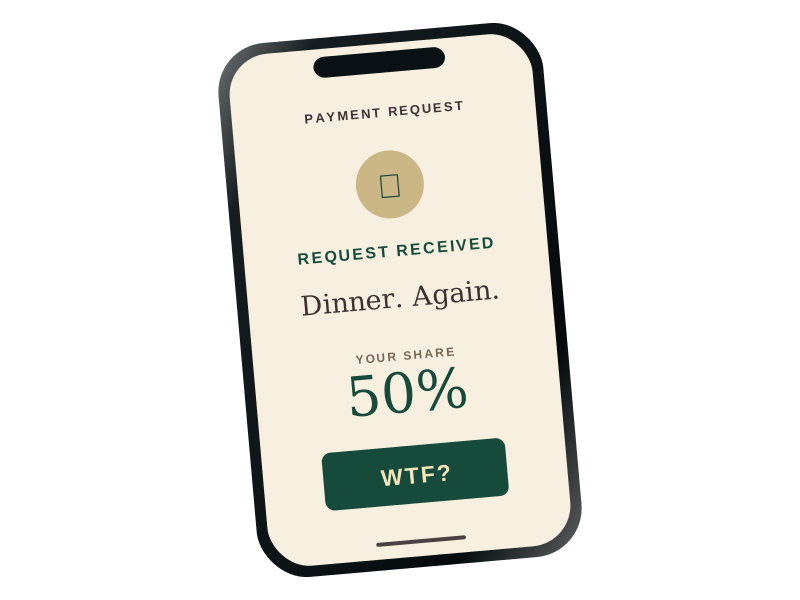
Excuse me.
Who ordered this?
If you choose the expensive plan, listen to the answer
There is responsibility on the other side of this conversation.
If you suggest a restaurant, a weekend away or a birthday celebration, the people you invite need a genuine opportunity to say what they can spend.
A budget is useful information. Treat it that way.
Do not keep recommending increasingly expensive options after someone has explained their limit. Do not describe a costly weekend as “nothing much” to a person for whom it would mean several difficult weeks afterwards.
And do not insist that everyone attend because friendship matters, while ignoring the cost of being there.
You have options.
Choose somewhere less expensive. Adjust the plan. Invite people to something they can comfortably enjoy.
Or offer to cover a specific difference because you want the experience together and can happily afford to give it.
Make the offer clearly enough that nobody has to wonder what it means.
Is it a gift? Which costs are included? Will you still feel comfortable with the arrangement afterwards?
A good invitation makes room for an honest answer.
Nobody should have to buy belonging at a price they have already said they cannot pay.
The joke that keeps reaching for your wallet
“You’re the rich one.”
“Come on, this is pocket change to you.”
“We know who’s paying tonight.”
Once, it might be a joke you enjoy.
Repeated often enough, it can become a way of making an expectation sound too light-hearted to challenge.
If you object, the conversation shifts. Now the problem is your sense of humour. Your sensitivity. The strange fact that someone with your income would care about a bill of this size.
But the amount may be the least interesting part.
What bothers you is the assumption. The moment in which your participation becomes financially useful before it becomes enjoyable.
You came to see people. They appear unusually attentive to what you can cover.
You can address that without presenting an audited account of every previous evening.
“I’m paying for mine tonight.”
“Let’s agree the costs before we book.”
“I like treating you sometimes. I don’t want it to become the expectation.”
Clear words give everyone an opportunity to respond honestly.
If the joke only works when you eventually pay, it deserves a closer look.
Family can make the expectation harder to name
Among relatives, money often comes wrapped in a longer history.
Someone helped you when you were younger. Someone remembers what your parents sacrificed. Someone believes success should circulate through the family, particularly when they have already decided where it should go next.
There may be gratitude you sincerely want to express.
There may also be responsibilities and support arrangements you have willingly taken on. Those deserve an honest conversation of their own.
But gratitude can become difficult to recognise when it is repeatedly used to settle a new request.
A holiday contribution. Another loan. A larger share of the celebration. Something described as urgent until the next urgent thing arrives.
“You’re doing well” becomes an explanation for why you should agree.
“We’re family” becomes the answer to any question about the arrangement.
You can love your family and want limits around what you provide. You can help one relative without making yourself permanently available to everyone.
You can also decide that a previous arrangement no longer works.
Being proud of someone’s success should not become permission to spend it.
My generosity.
My choice.
Lending money does not need to prove the relationship
A request for a loan can make affection feel as though it is being examined.
The person asking may genuinely need help. You may care deeply about what they are facing.
You can still be unwilling to lend.
Perhaps an earlier loan remains unpaid. Perhaps you cannot comfortably risk the amount. Perhaps you know that waiting for repayment would change how you felt every time their name appeared on your phone.
You do not have to pretend that last concern is trivial.
Money can enter a friendship quietly and then occupy every room in it.
You notice the new purchase. They avoid mentioning an outing. You feel awkward asking. They become defensive before you have finished the question.
Sometimes the most honest answer is the one given before the transfer.
“I’m not able to lend money.”
“I won’t be making another loan.”
“I can offer this amount as a gift, but I can’t take on more.”
Use the answer you mean. Do not offer a gift you will later resent or describe a refusal as temporary if you have already decided.
Someone’s disappointment does not automatically make your decision unkind.
It may simply mean they hoped you would say yes.
Fairness needs an agreement
There are many ways friends can organise money.
Each person pays for what they ordered. A shared meal is divided equally. People take turns. One person offers to host. A group agrees in advance that someone will cover a particular cost.
Different arrangements can work when the people involved understand and accept them.
Trouble grows in the gap between what one person offered and what everyone else assumed.
You thought you were buying dinner.
They thought the whole evening was yours.
You agreed to cover the accommodation.
Someone included the restaurants, taxis and drinks.
You offered to help with a present.
Your contribution somehow became the rest of the budget.
These misunderstandings become easier to address when costs are discussed before everyone has enjoyed spending the money.
It may feel less spontaneous to ask what the plan includes. It is usually a better beginning than resentment after the event.
Fairness should be something people agree on, rather than something announced to the person holding the bill.
What happens when you stop paying?
This can be the revealing part.
Some people will be embarrassed that you had to mention it. They may not have realised the pattern had developed. They adjust. The next evening is easier.
Leave room for that possibility.
A habit can be thoughtless without being deliberately exploitative.
Others may argue with the limit itself.
They question why you care. Remind you of what you earn. Suggest that money has changed you. Become colder when you stop making it available.
Pay attention to the pattern over time.
Does the invitation remain when the subsidy disappears?
Can you suggest a simpler plan and still receive enthusiasm?
Are people interested in spending time with you when there is nothing expensive attached?
You do not need to turn every friendship into a test. You can notice how it responds to an ordinary financial boundary.
The relationship should still have something to offer when your wallet stays in your bag.

PLEASE KEEP YOUR RECEIPT.
You were invited
for your company.
Remember?
Generosity should feel like something you gave
I want to be able to buy dinner for people I love.
Choose a beautiful present. Help when I can. Make an evening possible because I have the means and the desire to do it.
I also want to recognise my own decision in the gesture.
An offer given freely can carry affection without a calculation. An expectation imposed repeatedly can leave the person paying feeling strangely absent from their own generosity.
That is a loss for the relationship.
The pleasure goes. The suspicion arrives. You begin wondering whether a request contains a need, a habit or a careful estimate of how difficult you will find it to refuse.
Honest arrangements protect something more valuable than the cost of dinner.
They protect the ability to give without feeling used.
Let me offer. Let me mean it. Let my answer sometimes be no.
More than the bill
Yes, I may be able to afford it.
I may also have worked hard to reach a place where I can choose what to do with my money. I may be proud of that, grateful for it and happy to share some of it.
You can celebrate that with me.
You can tell me what is difficult for you. Suggest a plan that suits your budget. Accept an invitation when I freely offer one.
What you cannot assume is that closeness gives you an automatic claim on the difference between our incomes.
I want a place at the table as your friend, your sister, your daughter or your cousin.
A person whose company you enjoy.
Someone you would still invite if the evening consisted of coffee at home and whatever biscuits were already in the cupboard.
My generosity is a choice.
It is not your budget.