


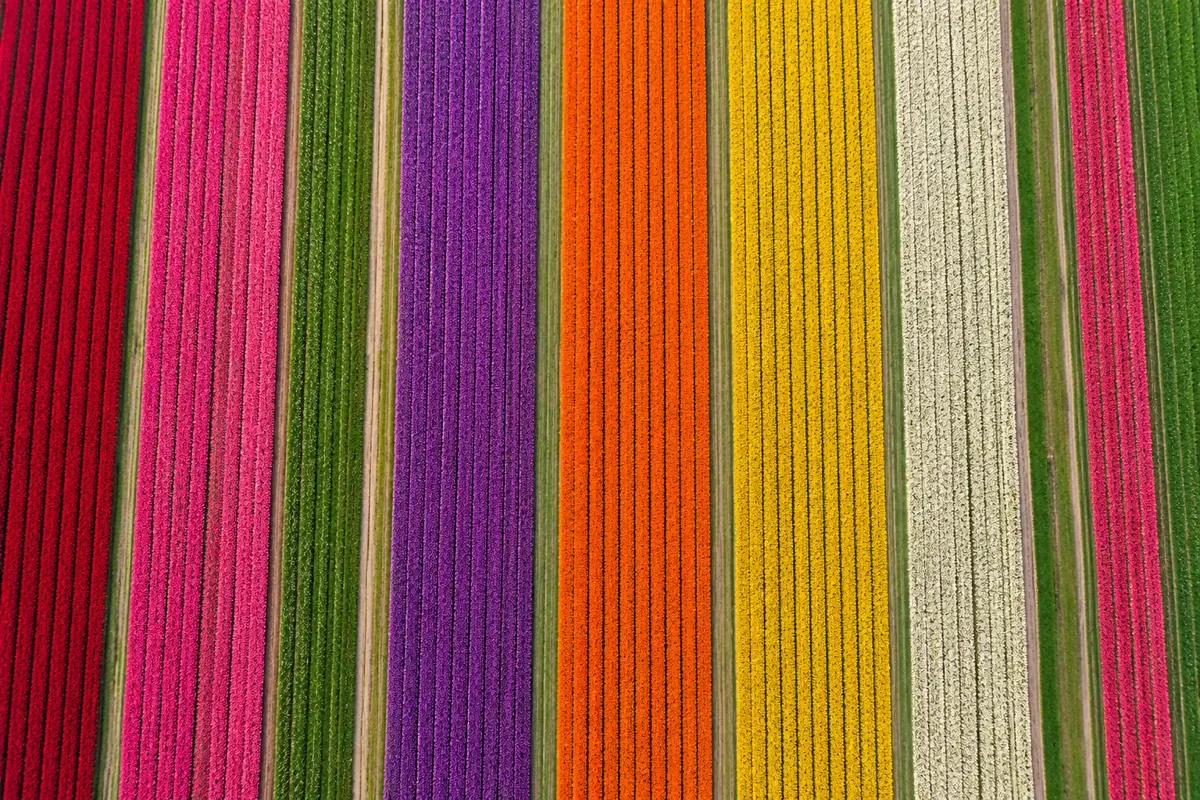
COLOUR OUTSIDE THE LINES
Lisse Spring Has Main Character Energy
Tulip stripes, a very short season and the wonderfully unreasonable ambition of planting millions of bulbs.
UNPACK THE STORY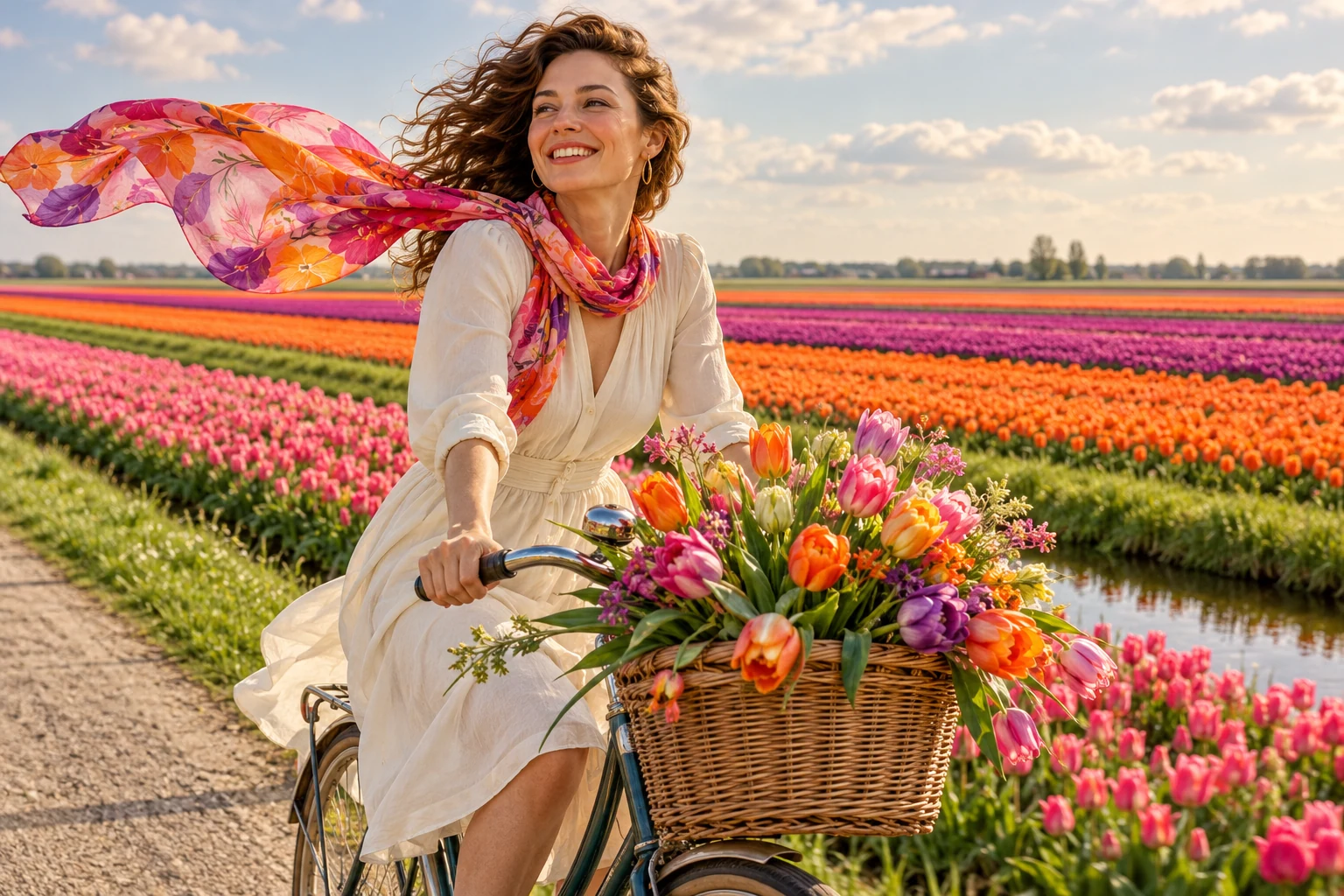

There are places that whisper their way into a travel plan. Lisse arrives in colour blocks. Pink beside orange, violet beside yellow, and green stitching the whole production together. From above, the bulb fields read like somebody organised an extravagant paint box with agricultural precision.
But spring here is not an endlessly available filter. The fields have a working calendar, and Keukenhof has a short opening season. To see the spectacle well, you need a little planning and a willingness to let the weather have its opinion. The flowers are alive. They have not signed a contract with your holiday dates.
Visual note: the imagery in this story is AI-generated editorial illustration, inspired by the destination. It does not document a visit or show the exact interiors of recommended businesses.
The flowers did not promise a date.
↙The garden with a closing date
Keukenhof’s own description centres on seven million spring-flowering bulbs. Not seven million tulips all opening simultaneously: a succession of bulbs, varieties and displays. That distinction makes the experience more interesting, and it explains why an image taken in one week cannot guarantee the same composition in another.
The garden opens for a limited spring season of roughly eight weeks. Check the official calendar for your year, then book through the official site. Treat claims about a universally perfect week with caution. You can plan the journey; you cannot personally negotiate with spring. Bring a layer for changing weather and give the garden more than an hour between transfers.
Source & further reading: Keukenhof · about the garden ↗Those stripes belong to someone
The fields around Lisse are part of the Bollenstreek’s bulb-growing economy. They are beautiful working land, not a public portrait studio. Stay on permitted routes and use a grower’s designated photo area if you want to be among the rows. A neat gap between plants is not an invitation.
Cycling can make the landscape feel more immediate than a succession of car stops. Choose a route matched to your confidence, the wind and the daylight available. Stop safely, keep paths clear, and do not let a photograph become somebody else’s traffic problem. A marvellous colour story still works when you remain on the right side of a field boundary.
Source & further reading: Keukenhof · official calendar and tickets ↗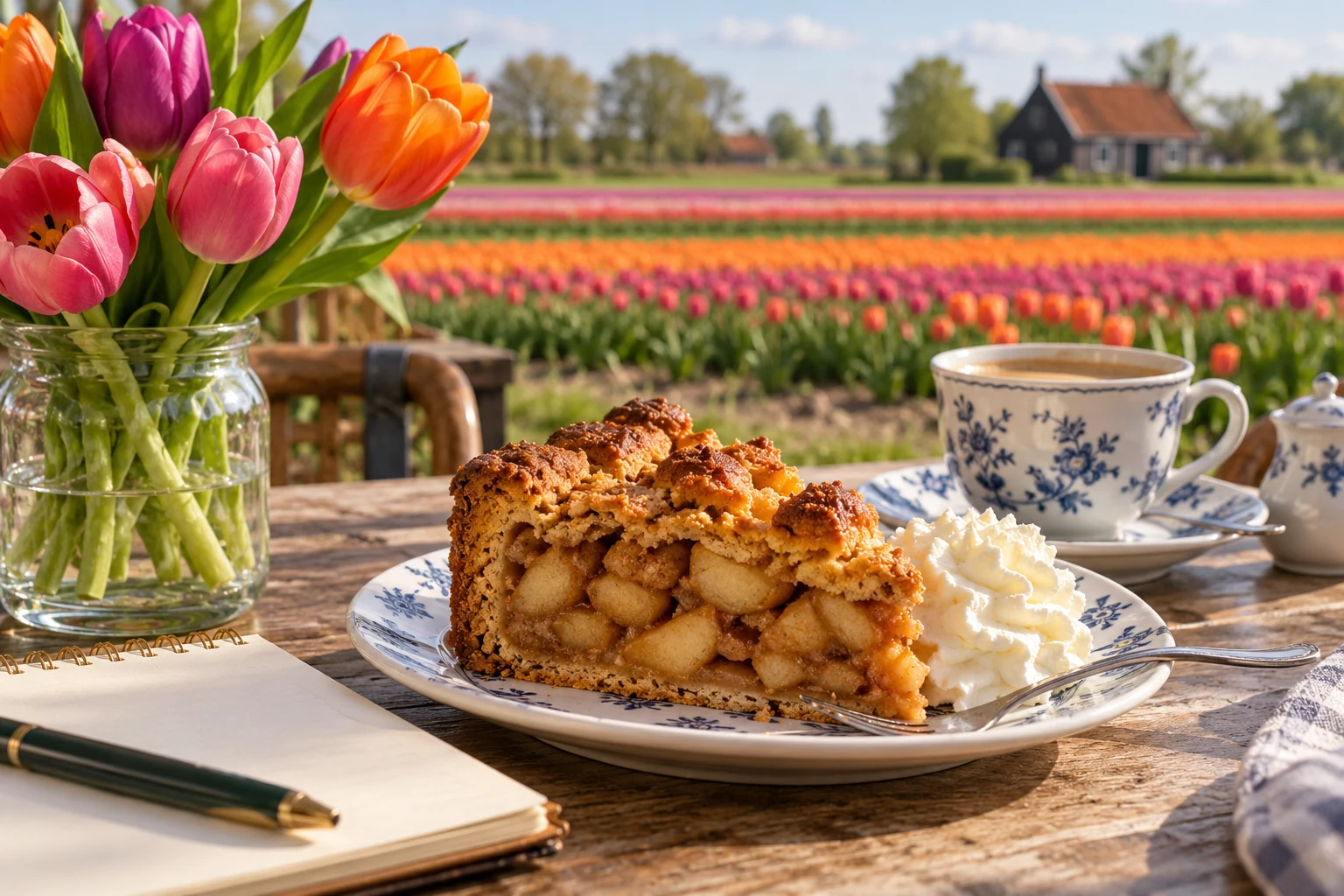
THE THING TO REMEMBERSeven million bulbs. Absolutely no intention of being subtle.
✳
The tulip has a passport
The flower did not originate as an exclusively Dutch possession. Its wider history reaches through regions of Asia and the Ottoman world before its association with European gardens and Dutch cultivation. That journey is more compelling than a one-line claim that the Netherlands simply invented its national floral image.
At Museum de Zwarte Tulp in Lisse, the story of bulb cultivation and the tulip’s changing cultural role gives the fields some depth. Add a museum stop when the weather is unhelpful, or simply because an industry deserves more than admiration from the roadside. The object you think you know often becomes much more interesting once somebody explains how it got here.
Source & further reading: Museum de Zwarte Tulp ↗Tulip mania, without the lazy legend
The speculative market associated with seventeenth-century tulips is irresistible magazine material: beauty, rarity, money and people persuading themselves that a price can keep rising. But stories about everyone selling a house for a bulb, an entire nation going bankrupt, or the world’s first bubble should not be repeated as unquestioned fact.
Keep the distinction between extraordinary prices, the contracts being traded and the larger social impact. The museum is a good place to investigate the story further. A flower does not become less fascinating when the headline gets more accurate. It just stops being a convenient prop in an economic fairy tale.
Source & further reading: Museum de Zwarte Tulp ↗Look around.Lisse · Zuid-Holland / ILLUSTRATIVE LANDSCAPE
Eat something that is not a flower
Build lunch into the plan before the day becomes one long negotiation with hungry companions. Het Vierkant gives you a village-centre pause, with De Vier Seizoenen as a concrete restaurant to investigate. On the separate Keukenhof estate, the Hofboerderij offers another setting for a break; the estate and the seasonal flower garden are not the same attraction.
Coffee and a slice of Dutch apple pie make a very respectable interval. So does an actual lunch if you are cycling. Check current menus, opening days and dietary options rather than assume a spring crowd will create a seat for you. The most photogenic day is improved considerably by a meal eaten sitting down.
Source & further reading: De Vier Seizoenen ↗Give the colour a second morning
A day trip is possible, but staying locally changes the rhythm. You can organise the garden and the surrounding area as two experiences rather than bolt them together. Look at a small village-centre B&B, or use nearby Leiden or Haarlem if a city base suits the wider journey better.
Leave with the idea of colour rather than the need to own the field. If buying bulbs for home, check the variety’s planting requirements and your destination’s import rules. Then return to the photograph with context: those stripes are the visible part of a much longer cycle of growing, timing and work. Spring gets the applause. The rest of the year builds the stage.
Source & further reading: Keukenhof · official calendar and tickets ↗The Lady’s
little black book

Worth the detour
- Keukenhof during its official spring opening season.
- Permitted cycling and walking routes through the Bollenstreek.
- Museum de Zwarte Tulp for the flower’s cultural and commercial history.
Come hungry
Restaurant De Vier Seizoenen
A village-centre lunch or dinner option on Het Vierkant. Browse the current menu and reserve for a fixed meal.
Hofboerderij · Keukenhof estate
Coffee, cake or lunch on the estate. Confirm access and current service; this is separate from admission to the spring flower garden.
Stay a little
De Vier Seizoenen B&B
A small-scale stay at Het Vierkant in Lisse’s centre, with the restaurant below. Check room details and spring availability early.
A city base nearby
Leiden or Haarlem can work if the trip includes more than flowers. Use the Keukenhof travel page to compare your actual transfer before booking accommodation.
A plan with room in it
- When
- The flower spectacle is seasonal. Consult the official annual Keukenhof dates and current bloom information; no single week is guaranteed.
- Getting there
- Compare seasonal public transport and official combination tickets before choosing a departure city. A car is not automatically the easiest option.
- How long
- A full day for a focused visit; one or two nights if you want a more relaxed garden-and-fields itinerary.
- One more thing
- Stay out of working fields unless a grower explicitly permits entry. Keukenhof garden and the castle estate are separate places.
Editorial shortlist, not a ranked list or a promise of availability. Venue information checked 31 October 2026. Opening days, transport, access and prices change; follow the linked operator for your dates. Illustrations do not depict the named hotels or restaurants.