


What comes next?
2 · 6 · 12 · 20 · 30 · ?
Show the reasoning +
42. The gaps are 4, 6, 8, 10, then 12. This example illustrates noticing a rule, rather than recalling a fact.
The brain, the test, the opportunity — and everything a number leaves out
WORDS / AJVAR LADY · 1 NOVEMBER 2026 · 7 MIN READ
UNFOLD THE STORY ↓
There is always somebody at the table who announces that a person is incredibly intelligent. Usually, the evidence arrives afterwards: a degree, a difficult job, a quick answer, a number mentioned with the casual precision of a luxury watch.
I am interested in the number. I am more interested in what we think it gives us permission to assume.
Does a high score mean good judgement? Does struggling at school mean a person cannot think? Is the quiet woman who notices the flaw in everybody’s plan less intelligent than the man who explains the plan very loudly?
These questions do not make intelligence testing useless. They make the conversation around it more responsible.
Intelligence is not simply the amount of information somebody can recite. Learning, reasoning, solving unfamiliar problems and adapting to changing circumstances all belong in the discussion. Remembering a fact and working out what to do when the facts change are related abilities, but they are not identical.
Psychometric tests sample particular cognitive skills under defined conditions. A well-designed assessment can tell us something useful about performance relative to an appropriate reference group. It cannot observe every decision a person will make, every relationship they will sustain or every original idea they might develop.
A score is a measurement produced by a method. Before treating it as a verdict, ask about the method: which test, which version, which comparison group, which conditions and which purpose?
The question is not whether a number can tell us anything. It is whether we are asking it to tell us everything.
The short answer is that cognitive development is complex. Genetic differences and environments both contribute; there is no single switch that produces intelligence. MedlinePlus describes the involvement of many genes alongside influences such as education, nutrition, healthcare and access to learning resources. These influences interact rather than arriving in separate sealed boxes. MedlinePlus Genetics ↗
Consider two children who are equally curious. One has reliable meals, a quiet place to read, patient adults and a school that recognises a difficulty early. The other is trying to learn while dealing with instability and interrupted schooling. Their later performances cannot sensibly be read as a clean experiment in innate potential.
This does not mean that differences in ability are imaginary. It means that an observed difference does not, by itself, explain its own origin. A population-level estimate of genetic influence is not a calculation of how much of one individual’s mind is fixed or how much improvement that person is allowed.
We should be particularly suspicious of anyone selling a simple biological ranking of whole social groups. A confident explanation requires evidence capable of separating the influences being claimed, not merely a dramatic chart.

For illustration, this scale uses a mean of 100 and a standard deviation of 15. These are statistical bands, not diagnoses or a universal set of clinical labels. The actual test manual and assessment context come first.
Scores have uncertainty. A low IQ score alone does not establish intellectual disability: adaptive functioning and developmental history also matter. Different tests can assign different numbers to a similar percentile. Mensa: why the scale matters ↗
The appealing picture is a brain with unused rooms: ordinary people occupy a small corner, while geniuses have found the keys to the rest. That is not a useful account of cognition. Different tasks recruit interacting systems; more visible activity is not automatically better thinking.
A demanding task can become easier with expertise. Someone who has spent years learning music, mathematics or a craft may recognise patterns that a beginner must work through slowly. Efficiency, knowledge and strategy matter. You cannot infer a person’s intelligence by counting how many coloured regions appear in an impressive illustration.
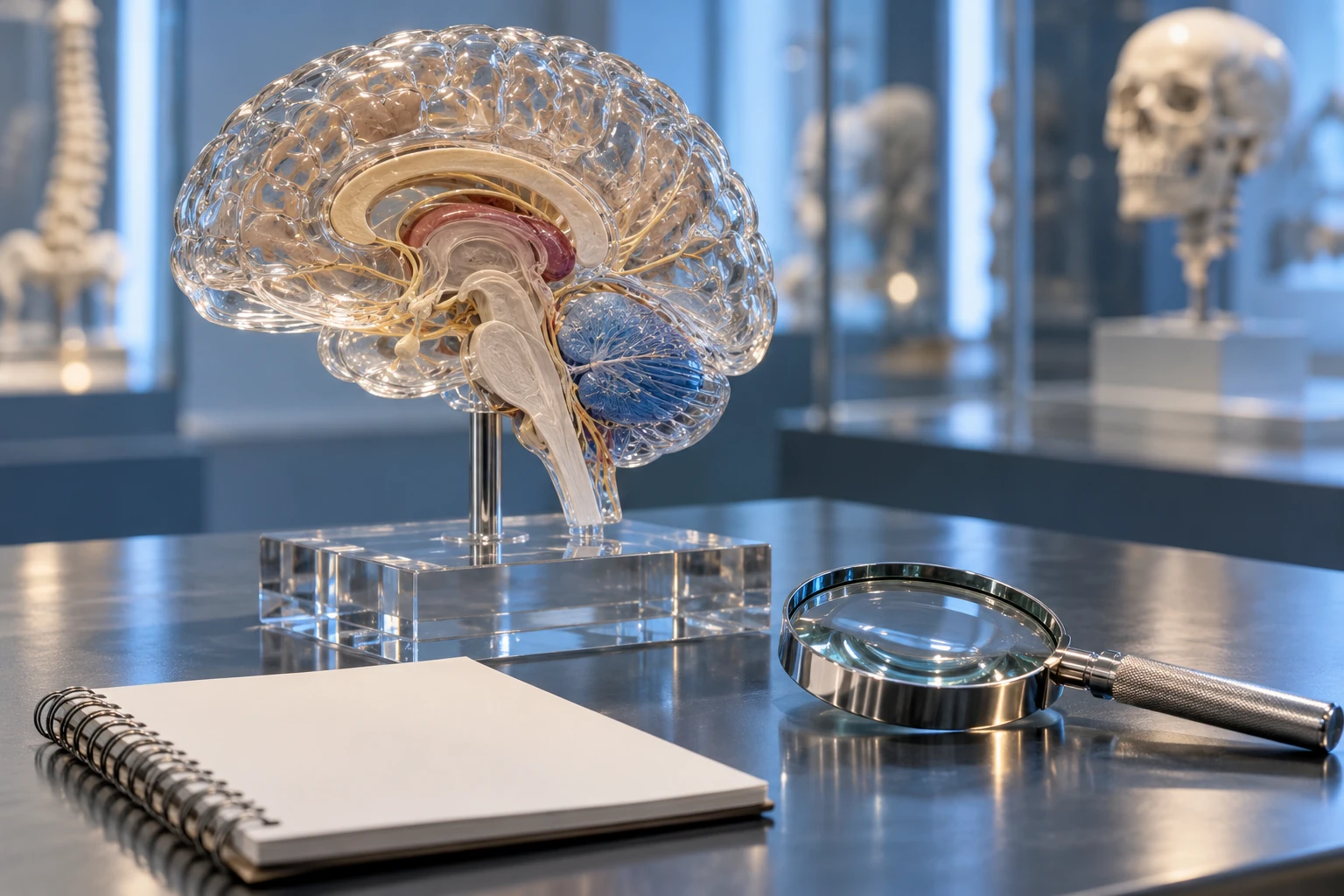
Nor should an anatomy model be mistaken for a diagnostic scan. The images in this story illustrate a subject. They do not reveal anyone’s cognitive capacity.
The practical question is more interesting than the mythical percentage: what helps this person understand, remember and use something new?

The early Binet–Simon scale, published in 1905, grew out of efforts to identify French schoolchildren who needed educational support. That origin matters. Assessment can be used to ask how teaching should change, rather than merely to decide who deserves an impressive label.
As testing spread, its purposes and assumptions changed. The history includes educational help and attempts to widen opportunity, but also damaging uses of scores to justify exclusion. An instrument does not carry its own ethical instructions. Institutions decide what consequences to attach to it.
The American Psychological Association’s discussion of testing describes both its potential and its limitations. That tension remains important: abandoning assessment can leave needs unidentified, while treating a result as destiny can close opportunities that should remain open. APA on intelligence and achievement testing ↗
A good assessment should lead to a better-informed decision. If all it produces is a hierarchy for dinner-party conversation, we have lost the more useful purpose.
Three original illustrations of task types. These are not copied items from a protected test, not a validated IQ test and not a way to calculate your IQ. Open each explanation when you are ready.
2 · 6 · 12 · 20 · 30 · ?
42. The gaps are 4, 6, 8, 10, then 12. This example illustrates noticing a rule, rather than recalling a fact.
Compass : direction
Thermometer : ?
Temperature. In this example each instrument gives information about the property named beside it. Language familiarity affects how a verbal item is experienced.
Three diamonds. Each row keeps its shape while the columns increase the count from one to three. Professional assessments use many items, standardised instructions and validated norms.
Other assessments may include memory, processing speed, vocabulary and spatial construction. The mix depends on the instrument and its purpose. For an authorised online practice activity, visit the Mensa IQ Challenge ↗; Mensa explicitly states that this entertainment activity does not qualify you for membership.
On many commonly used scales, the reference mean is set at 100. This is a convention of standardisation, not a natural boundary between adequate and inadequate human beings. Different tests have different scales, and an apparently identical number can mean different things without the relevant norms.
A properly interpreted result also has uncertainty. It belongs in a report that considers the assessment conditions and the pattern of strengths and difficulties, not only the headline figure. An internet quiz offering a flattering certificate is not interchangeable with a professionally administered, validated assessment.
Cognitive tests can be useful in educational and clinical decisions. Their limits do not erase that usefulness. But they do not directly measure kindness, courage, reliability, moral responsibility or the ability to make another person feel safe.
A very intelligent person can behave foolishly. A person who has never taken an IQ test can notice the most important thing in the room. Neither observation requires us to deny the existence of measured cognitive ability.

High-IQ societies are social organisations with admission criteria, not public authorities awarding human value. Mensa requires performance in the top two per cent on an accepted, properly supervised test. Intertel uses the 99th percentile, and the Triple Nine Society the 99.9th percentile, with their own accepted tests and documentation rules.
Percentiles are more useful here than a universal raw IQ number. For illustration only, on an idealised scale with mean 100 and standard deviation 15, those thresholds are approximately 131, 135 and 146 respectively. An organisation’s actual approved-test table controls admission; do not substitute these rounded illustrations for it.
Joining may offer companionship and stimulating discussion. Not joining tells us nothing definite about a person who has never applied, never been assessed or simply prefers another kind of community. Curiosity does not require a membership card.
It is sensible to work on skills you can practise: learning a subject thoroughly, checking an assumption, explaining an argument clearly and noticing when evidence contradicts a favourite conclusion. That is different from promising that one app or supplement will transform general intelligence.
A useful learning routine begins with a real task. Read something slightly beyond your comfort zone. Try to explain it without looking. Identify the part you cannot explain. Seek feedback, then return to it. The point is not to perform intelligence; it is to improve understanding.
Ask better questions in company too. What would change our minds? Which part do we know, and which part are we guessing? Is this a problem of reasoning, missing information or a disagreement about values?
Those questions can improve a conversation even when nobody’s measured IQ changes. There is considerable room between being impressed by a mind and actually using your own.

There is no defensible all-history IQ ranking here. Numbers circulating for people who were not assessed on comparable tests are not measured results. *Ronald Hoeflin’s interview describes vos Savant’s historical Guinness-listed 228; this reported older score should not be read as directly comparable with modern deviation IQs or as proof of the “most intelligent person ever”. Read the interview and its context ↗
We like labels because they shorten the work of understanding somebody. Gifted. Slow. Brilliant. Not academic. Sometimes a label opens a door to support. Sometimes it becomes a door that other people keep shut.
I would rather ask what a person understands, what they want to learn and what gets in the way. That approach leaves room for both genuine strengths and genuine difficulties. It does not require pretending that everyone has the same abilities.
The next time somebody announces a spectacular score, you can be interested. You can ask which test it came from. You can also continue the conversation long enough to discover whether the person listens.
A measurement can describe a performance. It should not become the ceiling of a life.
Original AI-generated editorial illustrations, including imagined historical scenes and symbolic objects. These are not archival photographs, research scans or documentary evidence.